
The Things That Hold a Community Together Are Never in Any Dataset
Tech can simulate being known convincingly enough that many of us will accept it. That's what worries me.

This afternoon, my husband sat me down and thanked me for things I didn’t even realize I had been carrying for years.
We have been doing these periodic check-ins - small touchpoint conversations where we pause and talk about how things are going in our lives and in our family. At first they felt slightly formal, the way anything intentional does when you begin. Over time they have become one of those grounding rituals that hold us together.
He thanked me for choices I had made over the years. Not taking certain jobs that would have advanced my career but required more time away from the children. Staying home during periods when our family needed stability. Choosing flexibility over professional opportunity when those decisions made life easier for everyone else.
He did not frame any of it dramatically. No violins played in the background. No one declared heroic sacrifice. He simply named the choices.
And somehow that simple act of acknowledgment touched something in me that had been sitting there for a very long time.
The strange thing is that I never made those decisions resentfully. I love my family, and many of those choices felt natural. But hearing someone reflect them back to me illuminated a part of my life that had always been assumed rather than seen.
In the Indian household I grew up in, gratitude did not usually work this way. You did not receive thanks for the things you did for the family. Those actions simply came with membership. Responsibilities were shared. Contribution was expected. Sacrifice was not something anyone paused to formally recognize because it was already woven into the structure of everyday life. That framework builds real resilience. But cultures that run on assumed contribution also develop a blind spot: when something becomes expected, people stop naming it. Over time those contributions blend into the background. They keep everything running, and they remain invisible.
The conversation - this afternoon, in our living room - made me realize how powerful it can be when someone takes the time to name those invisible things.
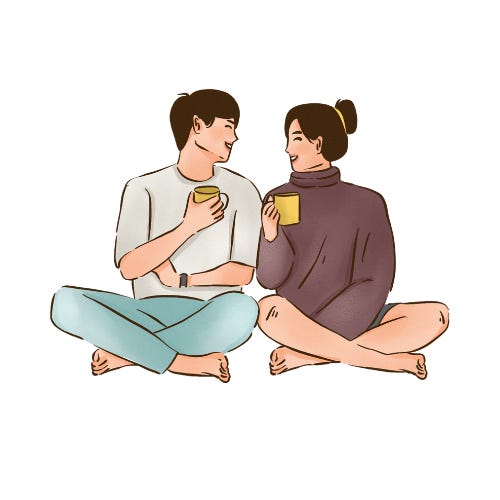
Almost every family runs on some version of this invisible ledger. Someone quietly absorbs disruptions, adjusts plans, or carries the emotional weight of keeping things steady. Very often - though not always - that person is a woman. Sometimes it is a parent, sometimes a partner, sometimes a sibling. Often, the rest of us only notice years later, when we look back and realize how many small decisions someone made so that the rest of us could move through life a little more easily.
Human beings want to be seen in ways that go beyond measurable achievement. We want the parts of ourselves tied to our values, instincts, and care for other people to be recognized.
I think about this often as a parent. One of the most meaningful things we can do for the people around us - children included - is to appreciate and honour the things that make them uniquely themselves. Their hobbies. Their strange fascinations. Their art. The interests they pursue with complete seriousness while the rest of us stand nearby wondering how anyone can care that deeply about katanas, football, or guitar pedals. Not despite our not understanding those passions, but sometimes precisely because we don’t. When someone says, “I see that this matters to you,” it creates a sense of belonging that goes far beyond simple praise for achievement.
I haven’t been able to stop thinking about it since.
We are living through a moment of extraordinary investment in making machines understand people. AI systems can now track your productivity, analyze your communication patterns, flag your emotional tone in an email, and build a behavioral profile sophisticated enough to predict what you will want before you know you want it. The technology is genuinely impressive. The pitch is irresistible: finally, a system that actually pays attention to you.

There are now AI companions designed to remember everything you say and reflect it back with warmth and consistency. Therapy platforms that use language models to offer what they call emotional support. HR tools that scan employee sentiment to help managers understand how their teams are feeling. Wellness apps that quantify your stress, your sleep, your mood, and present it all back to you as insight.
Silicon Valley would very much like you to believe this constitutes being seen.
It doesn’t. And the gap between the two is worth understanding, because it is not a temporary limitation. It is a structural one.
What my husband did this afternoon was not analysis. He did not audit my contributions or run the numbers on years of quiet decisions. He witnessed them. There is a difference that matters. Measurement produces data. Witnessing produces recognition. One tells you what happened. The other tells you that it mattered.
Witnessing requires something that cannot be trained into a model: the choice to pay attention to another person, sit with what you see, and decide it deserves to be said out loud. Not because a prompt asked you to. Not because an algorithm flagged an emotional need. Because you chose to.
The more interesting problem is not that AI cannot do this. It is that AI can simulate it convincingly enough that many people will accept the simulation. An app that remembers your preferences and asks how you are doing can feel like being known. A platform that reflects your patterns back with apparent care can feel like being understood. We are not good at distinguishing between the real thing and a well-designed approximation, especially when we are tired or lonely or simply grateful that some-‘thing’ noticed.
This is the part that bothers me. Not that AI is replacing human connection in some dramatic, obvious way. But that it is quietly raising the threshold for what we bother to do ourselves. Why sit down with someone and do the difficult, imperfect work of witnessing them when there is an app that does something that looks nearly identical and never gets it wrong?
My husband got it right this afternoon. But he could also have gotten it wrong. He could have named the wrong things, used the wrong tone, misjudged how I felt about those years. The vulnerability in real witnessing - the fact that it can fail - is the whole point. It is what makes being seen by another person feel different from being seen by a system.
That capacity is something worth actively protecting.
So today I decided to say thank you more often. Not only for the big gestures that naturally draw attention, but also for the quiet decisions and invisible acts of care that hold our lives together.
Those things will never appear in any algorithm’s dataset and are very often the parts that matter most.